My second month with Substack. I Stopped Pushing the Tools.
74 subscribers, 118 notes, a reel pipeline you can install in one line — and the SaaS apps I quietly stop develop more.


Hi, I’m Daniel — a software engineer, solo builder, and the person behind Digital Craft Workshop.
I’ve spent ten years writing TypeScript, .NET, and React for a living, and the last few of them building things alongside the day job: B2B SaaS, AI tools like Article Forge, internal infrastructure, and a Unity 2D narrative game. Some shipped. Some I killed. Both are useful.
Digital Craft Workshop is for developers, AI builders, and indie founders who’d rather understand the craft than ride the hype — the kind of reader who likes Domain-Driven Design, distrusts gurus, and wants AI that’s cheap, practical, and accountable to one engineer in a workshop.
Each essay is something you can read in one sitting and use the same week: an architecture pattern, an AI workflow a single developer can actually run, a build log, or a postmortem on a project that didn’t make it. Built carefully. Explained plainly. Owned by you.
TLDR
Month one I had an identity crisis. Month two I had a realization: most of what I built doesn’t need to be marketed.
Subscribers grew from 40 to 74 anyway. The work I expected to drive that growth didn’t.
The actual lever was recommendation swaps. So I’m keeping the SaaS apps running for myself, pointing the marketing budget at the Reel Pipeline Kit, and quietly turning paid subscriptions on. (Plus a return to a game I shelved in April.)
Subscribers went 40 → 74. I spent the month feeding a Notes engine that was supposed to drive that. The growth came from somewhere I wasn’t even working on.
So this month I stopped pushing the tools.
A month ago I wrote a piece called One Month of Digital Craft Workshop. The hook was an identity crisis — I’d been calling myself a founder, then renamed everything and started calling this place a workshop instead. 42 subscribers, five tools, zero ad spend.
I figured month two would be about scale. More notes. More posts. More tools shipped. A bigger number at the top.
It mostly was. The bigger number just didn’t come from the work I planned for it.
The numbers
Subscribers: 40 → 74. +34 in May. +85% month over month. One paying.
Substack posts: 6 published.
Engagement work: 100+ restacks of other people and dozens of comments, all planned, drafted, and reviewed by hand.
New subs directly attributed to a Note: 1.
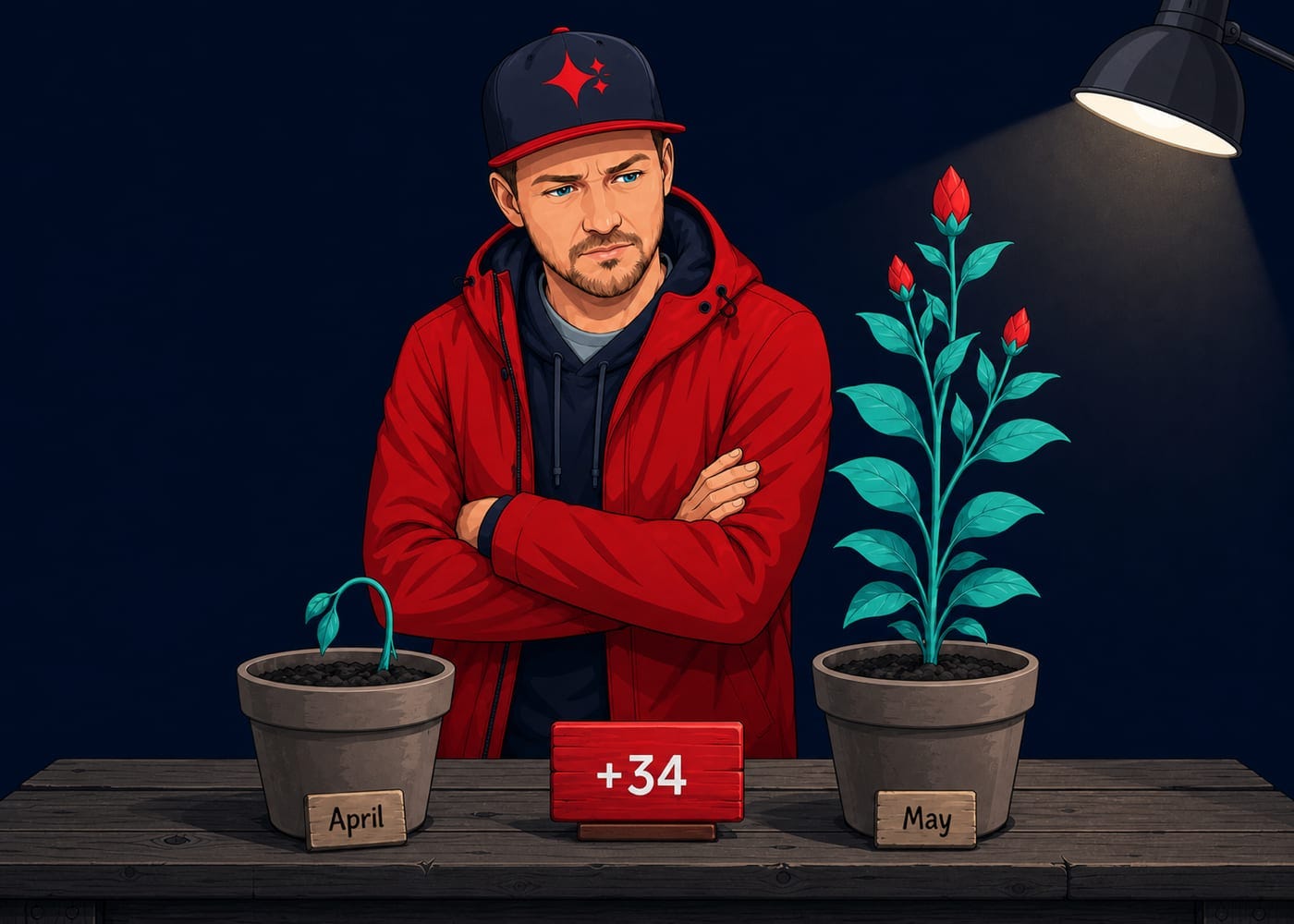
That last bullet is the one I’ve been staring at for two days.
The Notes engine is real. It’s also not pulling its weight.
I spent April and most of May building a system called grownote. It drafts Notes, comments, and restacks in my voice, schedules them across the day, and gives me one review interface to approve or rewrite each one before it ships.
The engine works. Notes go out on time, in my voice, with the angles I asked for. Technically: done.
The honest part: AI drafts everything, but I review everything. Notes I won’t publish if they aren’t true — and I can’t automate “is this true.” So every Note still costs me real evening time. Cheaper than writing from scratch, but not the hands-off engine I was picturing in April.
And the attribution is what it is. One direct subscriber attributable to the whole month of Notes. The other 33 came from somewhere else.
Where the growth actually came from
When I scrubbed the source field on the 34 new May subs, the pattern was clear: most of them arrived through recommendation swaps and the Substack discovery network. Readers saw me on someone else’s dashboard, clicked through, subscribed.

That’s the boring part of Substack growth. No engine required.
By end of May I had enough working swaps in place that the channel feels real. It’s not the thing I have to push in June — it’s the thing that’s already pulling while I push the next one.
What I stopped marketing (not what I stopped using)
I have three SaaS apps live. Drippery is the email drip tool, Subhook is a generic email-to-API webhook, and Archieve Concierge is a search-over-my-own-archive tool. All deployed. All working. All three are still part of how I run this workshop.
I’m not killing any of them. I use them every week. Drippery sends the welcome sequence to everyone reading this. Subhook handles inbound mail for two of my projects. Archieve Concierge sits inside the library widget on my homepage.
But I stopped marketing them.
Drippery was the loudest. For two months I wrote posts about it, tried to assemble a beta cohort, planned an AppSumo launch. Beta testers didn’t show up. The AppSumo path quietly died.
The feedback I expected — even harsh feedback — didn’t arrive. People reading my Drippery posts weren’t telling me what was wrong. They were just not signing up.
There’s a version of me that would read that as a problem to solve harder. Different hook, different landing page, tenth pivot.
The May version of me read it as a signal. Drippery’s marketing moment might come later. I’m not going to spend my best evening hours feeding a thing that isn’t sending feedback back.
So it stays alive. I use it. The marketing budget goes elsewhere.
I flipped paid subscriptions on
Sometime in the middle of May, I quietly switched paid subscriptions on for this newsletter for the first time. Three tiers, modest expectations.
Free readers keep getting every public post — and now, 5 Archie queries a day. Archie is the AI librarian I built on top of my back catalog. Ask it a question, it answers from every post I’ve written across Medium, Substack, Hashnode, and dev.to.
Paid subscribers get three things:
Exclusive product access to Archie (unlimited queries) and Drippery (full plan).
The Vault — the skills, routines, and content/growth playbooks I actually use in this workshop.
Member perks — Gumroad discounts on future products (Reel Pipeline Kit included), early access, priority Q&A.
Founding members get all of the above plus exclusive support on any of my products and first say on what I build next.
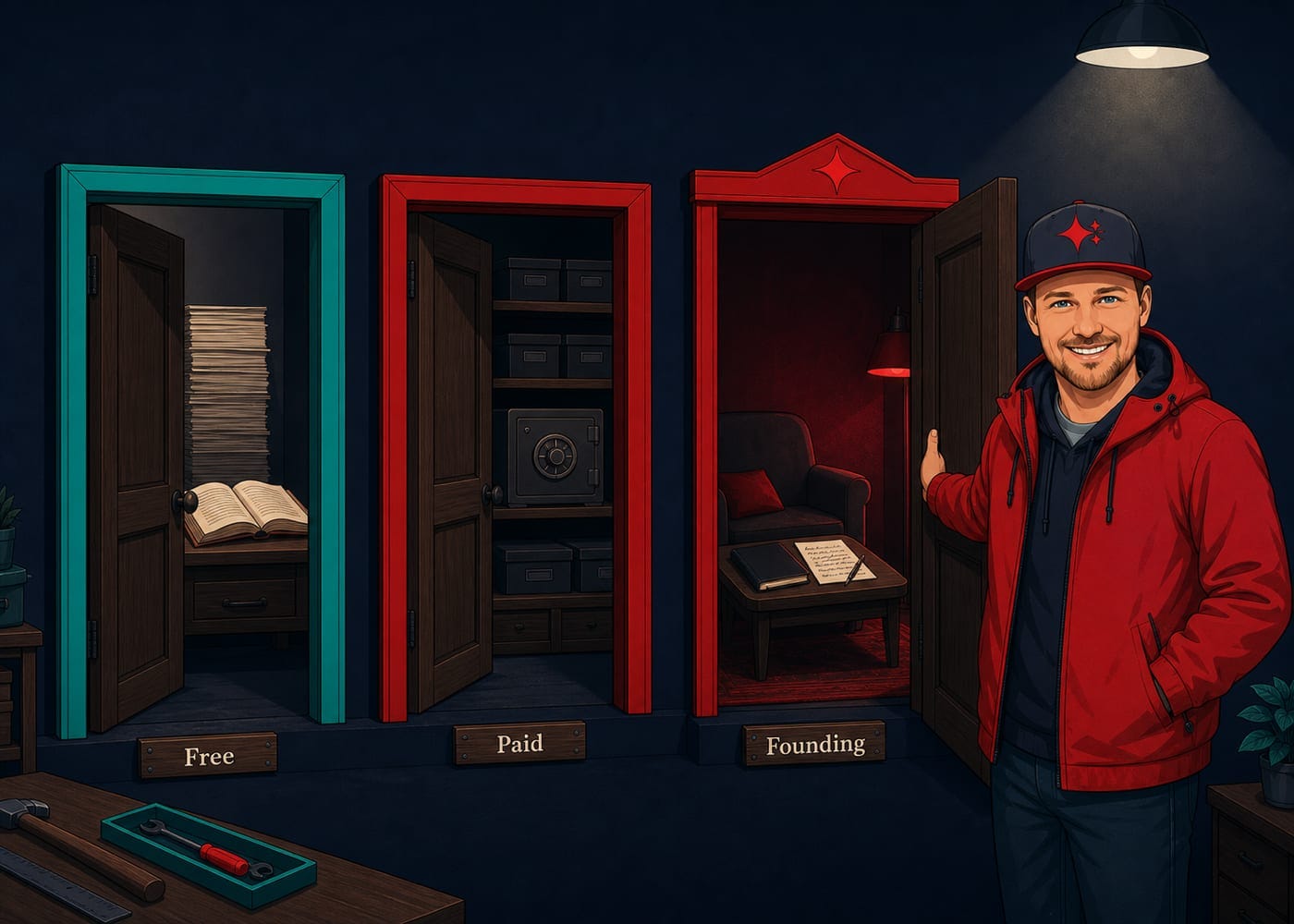
One paying so far. Not a flood. But the doors are open and the price tag is set, which means June can answer a question May couldn’t even ask.
What I’m pushing instead
The thing I’m putting marketing energy behind, starting now, is the Reel Pipeline Kit.
It’s a local app. One install command after purchase.
You paste a Substack article URL. The app writes a 30-second scenario and renders narration — Kokoro (free local TTS) or ElevenLabs for a cloned voice. Optionally it animates each scene on a local GPU or via Replicate.
Out comes a 9:16 MP4. Drop it in a Note, a Reel, or a Short.
It’s the engine I used to make my own reels, and I’m packaging it for sale on Gumroad. Bring your own keys — your Anthropic key, your ElevenLabs key, your GPU or Replicate budget. Nothing routes through a server of mine. You install it once on your machine and own the pipeline.
The companion content is the multi-post Substack series I started May 15 — I Taught My Articles to Make Their Own Reels.

The hub is live. Two follow-up parts are live. The remaining parts are drafted — scenario writing with Haiku, the captions system, the Wan i2v clip stage (image-to-video on a local GPU), the render side.
Why this one and not Drippery? Honest answer: I built the kit for myself, used it for a month, and it does something I want to do more often. That’s a stronger starting position — I already use the thing.
And one more thing
I opened the Unity project for Eli and Uri for the first time in months.
It’s the narrative puzzle-adventure I’ve been building under Echoes Within Games. I shelved it in April because the SaaS sprint needed every evening. I sat with it again last week for an hour. The spark was still there.

So month three carries something I didn’t expect to add back this soon: a slow, quiet return to the game. Not a sprint. Not a deadline. Just evenings where the game gets some of the focus the SaaS marketing used to swallow.
And there’s a quiet sibling thread to watch. I just shipped my first auto-generated gameplay reel — same Reel Pipeline architecture, but the input is Unity gameplay footage instead of an article. If that pipeline holds up across a few more runs, there’s a second product hiding in it: a Unity Game Reel Pipeline. Not promised. Not roadmapped. Just a thread I’m pulling on.
What I shipped in May (build-log shorthand)
Skim if you’re not in the plumbing.
Article Forge:
video_jobsqueue, MCP tools for enqueuing reels from claude.ai, restack-video-note format, TLDR format, 4-second muted-autoplay note format, Kokoro local TTS fallback, video-worker daemon polling on my home PC.grownote: Notes engine v2 with feed-pool sourcing, article-promo MCP, angle categorization, Clerk auth, comment redraft as fresh reaction, restack dedupe against history.
Drippery: OAuth 2.0 + Dynamic Client Registration so it’s a real MCP server, Telegram bot per tenant replacing ntfy, dashboard refresh, manual send mode, Reply-To setting.
Subhook: admin analytics, Telegram relay, dropped min-machines to 0, pre-push hook installer.
Archieve Concierge: Hashnode indexing, Notion ingest pipeline, cross-DB join fix.
Cross-cutting: Umami self-hosted analytics across every project, ai-video-studio PC provisioned and on Tailscale.
A lot of those landed on weeks when I’d “decided” not to push the project they belong to. Apparently I can stop marketing a thing without stopping shipping to it. Good to know.
Bigger look on Digital Craft Workshop can be find at homepage.
What I got wrong
I projected Notes as the dominant growth lever. The actual lever was recommendation swaps. If I’d known that on May 1, I’d have spent at least half the Notes time on swap conversations instead.
I also let an early-April research session — Claude doing the math on optimistic comparable-newsletter growth — float a 1,500–2,000 sub target by end of June. Reading it now, that was a hallucinated ceiling, not a plan.
I recalibrated mid-May to 200–400. That feels honest. At +34/month I’d land mid-range — which would actually feel like progress.
Acceptable. Not exciting.
What month three looks like
Finish the Reel Pipeline Kit and ship the Gumroad page. Wrap the rest of the six-post series.
See what the paid tier actually pulls now that the doors are open.
Cut Notes volume from ten-a-day to four-a-day, all human-planned, prioritized for restack-worthy angles.
Slowly return to Eli and Uri evenings. No sprint, no deadline.
Keep watching the Unity gameplay-reel thread. If a second pipeline forms cleanly, there’s a second Gumroad page in July.
Don’t market Drippery. Use it. Let June prove me right or wrong on that call.
42 → 74 in two months on $0 ad spend isn’t a chart anyone screenshots. But it’s the chart I have, and it’s pointing the right direction.
The work in front of me is finishing what I’ve started. The next engine can wait.
That’s month two. Workshop’s still open.
— Daniel